

Rubber Mexico
Transfer Molding
Transfer Molding
Transfer molding is a versatile manufacturing process that combines elements of both injection molding and compression molding to produce high-quality, detailed, and high-strength components. This method is particularly valued for its ability to create parts with excellent surface finishes and precise geometries, making it well-suited for industries where precision and durability are critical, such as in the production of electrical components, seals, and specialized industrial parts.
-
Precision & Efficiency with Transfer Molding
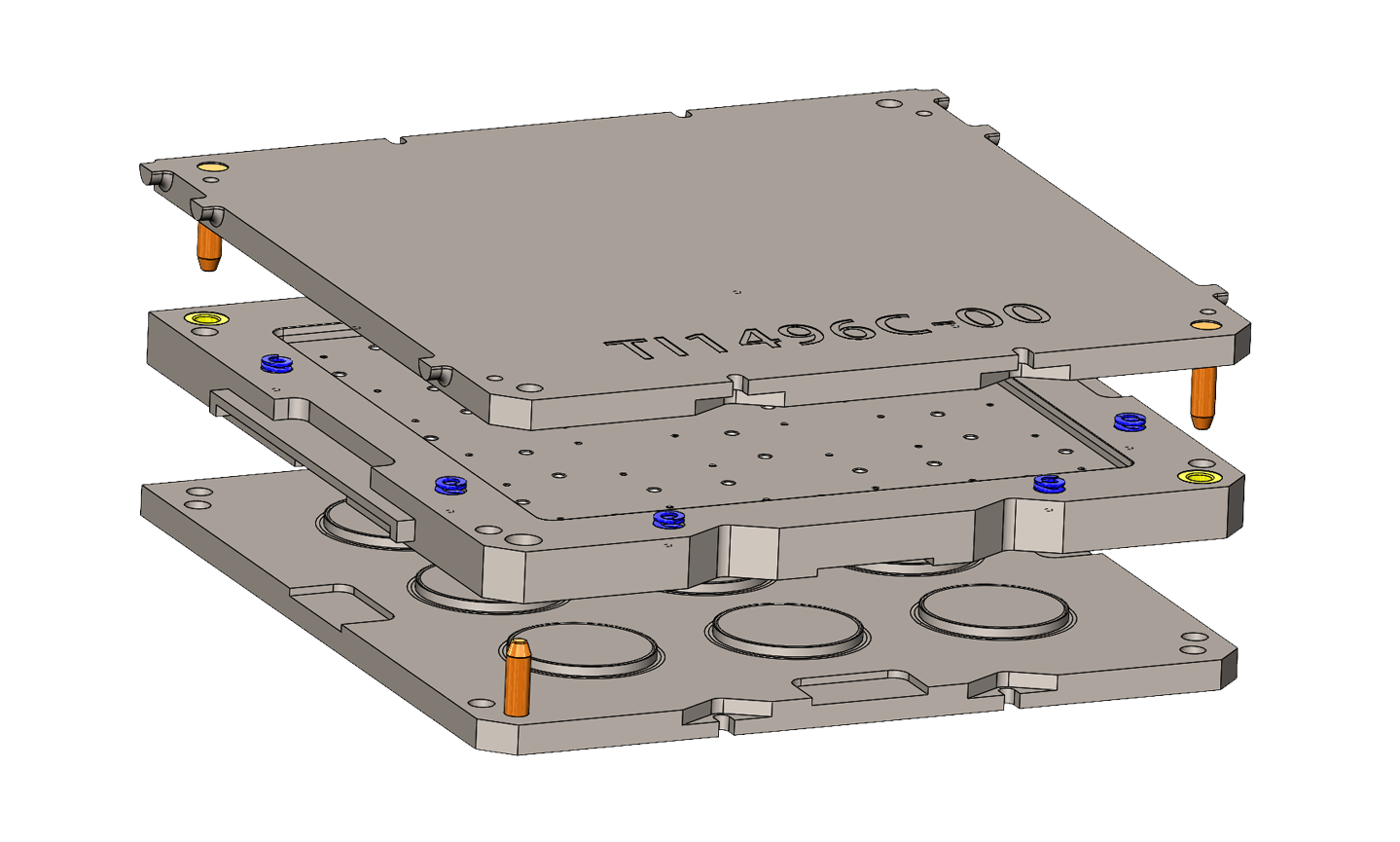
Transfer molding is a process that makes the most sense for many medium to high running parts that are small in size or that need added precision that compression molding cannot offer. Transfer molding works by having additional plates above the typical plates with the cavities seen in compression molding. The plates with the cavities are first closed, and then a plunger plate closes injecting the rubber in the pot into the cavity. Since the plates with the cavities are closed prior to introducing the material tighter tolerances, less or even sometimes virtually no flash can be left in the parting lines. Transfer molding also works great for molds with many cavities where it would be difficult to use preforms that do not produce a lot of waste in compression molding. Runners are used similar to what is seen in injection molding to fill up the various cavities with material.
-
Minimizing Waste with Cold Pot Transfer Molding
For high volume parts where minimizing the unit price is of upmost importance we use specially designed molds to keep the raw material "pot" cold in a process cold cold pot transfer molding. With traditional transfer molding all of the rubber placed in a mold in a cycle is cured between the part, runners, flash and the excess material left in the pot. With cold pot transfer molding the amount of scrap is greatly reduced. The only scrap is the minor amount of material left in the runners and sometimes flash. This allows us to decrease our material consumption and provide the most competitive pricing for high volume parts.
-
Advanced CNC Mold Technology for Flash-Free Parts
We manufacturer our rubber molds internally with our 37 precise CNC machines. We have the experience and know how to make essential flash free parts in many applications. A lot of knowhow, precision, and techniques go into making these molds that result in parts that do not require additional deflashing after the molding process. For parts that use our flashless mold technology it allows us to save cost that we can pass on to our customers in the deflashing process. Cryogenic deflashing is a very expensive process, and other more manual techniques are hard to scale and labor intensive.
Need a quote?
Don't hesitate and reach us! Our customer service team would be happy to assist you.
You might be interested
-

How Custom Window Seals Are Made: Extrusion vs....
Custom window seals can be manufactured through rubber extrusion or compression molding, depending on their geometry. Extrusion is generally suited to continuous profiles with a consistent cross-section, while compression molding...
How Custom Window Seals Are Made: Extrusion vs....
Custom window seals can be manufactured through rubber extrusion or compression molding, depending on their geometry. Extrusion is generally suited to continuous profiles with a consistent cross-section, while compression molding...
-

How to Design Parts for Rubber Compression Molding
Why Part Design Matters in Rubber Compression Molding In industrial manufacturing, the long-term performance and unit cost of a component are established long before the first production cycle begins. When...
How to Design Parts for Rubber Compression Molding
Why Part Design Matters in Rubber Compression Molding In industrial manufacturing, the long-term performance and unit cost of a component are established long before the first production cycle begins. When...
-

Injection Mold Design Considerations for Rubber...
When manufacturing high-precision elastomeric components, the engineering phase sets the foundation for production success. Developing a robust injection mold is the single most critical factor in determining the ultimate quality,...
Injection Mold Design Considerations for Rubber...
When manufacturing high-precision elastomeric components, the engineering phase sets the foundation for production success. Developing a robust injection mold is the single most critical factor in determining the ultimate quality,...
-

Rubber Extrusion vs Compression Molding: Key Di...
Selecting the right production method for industrial components is a critical decision that impacts every stage of a product's lifecycle. In the world of rubber manufacturing, two processes dominate the...
Rubber Extrusion vs Compression Molding: Key Di...
Selecting the right production method for industrial components is a critical decision that impacts every stage of a product's lifecycle. In the world of rubber manufacturing, two processes dominate the...
-

Dimensional Inspection Challenges in Custom Mol...
For OEM engineers and technical buyers, dimensional inspection is often treated as a straightforward quality step: compare a part against the drawing and confirm it is within tolerance. In practice,...
Dimensional Inspection Challenges in Custom Mol...
For OEM engineers and technical buyers, dimensional inspection is often treated as a straightforward quality step: compare a part against the drawing and confirm it is within tolerance. In practice,...
-

Compression Molding Companies: When This Proces...
In the complex landscape of industrial production, selecting the right fabrication method for rubber components is a critical decision that impacts product performance, durability, and total cost of ownership. While...
Compression Molding Companies: When This Proces...
In the complex landscape of industrial production, selecting the right fabrication method for rubber components is a critical decision that impacts product performance, durability, and total cost of ownership. While...
-

Custom molded rubber parts for industrial appli...
In the complex landscape of modern manufacturing, the success of a massive piece of machinery often depends on its smallest components. Among these, custom molded rubber parts serve as the...
Custom molded rubber parts for industrial appli...
In the complex landscape of modern manufacturing, the success of a massive piece of machinery often depends on its smallest components. Among these, custom molded rubber parts serve as the...
-

What Injection Molding Companies Must Control t...
In rubber injection molding, part quality is never accidental. Critical process parameters such as temperature control, injection pressure, material preparation, and cycle consistency directly impact dimensional accuracy, durability, and repeatability....
What Injection Molding Companies Must Control t...
In rubber injection molding, part quality is never accidental. Critical process parameters such as temperature control, injection pressure, material preparation, and cycle consistency directly impact dimensional accuracy, durability, and repeatability....
-

Injection Molding vs Compression Molding: How Y...
When OEM buyers and product engineers evaluate rubber components, one of the most common early-stage questions is: Should this part be produced using injection molding or compression molding? Choosing the...
Injection Molding vs Compression Molding: How Y...
When OEM buyers and product engineers evaluate rubber components, one of the most common early-stage questions is: Should this part be produced using injection molding or compression molding? Choosing the...
-

Rubber Molding Processes: Compression, Transfer...
Rubber manufacturing offers several molding processes designed to meet the technical, geometric, and production requirements of each application. Choosing the right molding method not only affects part performance, but also...
Rubber Molding Processes: Compression, Transfer...
Rubber manufacturing offers several molding processes designed to meet the technical, geometric, and production requirements of each application. Choosing the right molding method not only affects part performance, but also...


